26 Foot Box Truck: How Many Pallets It Fits
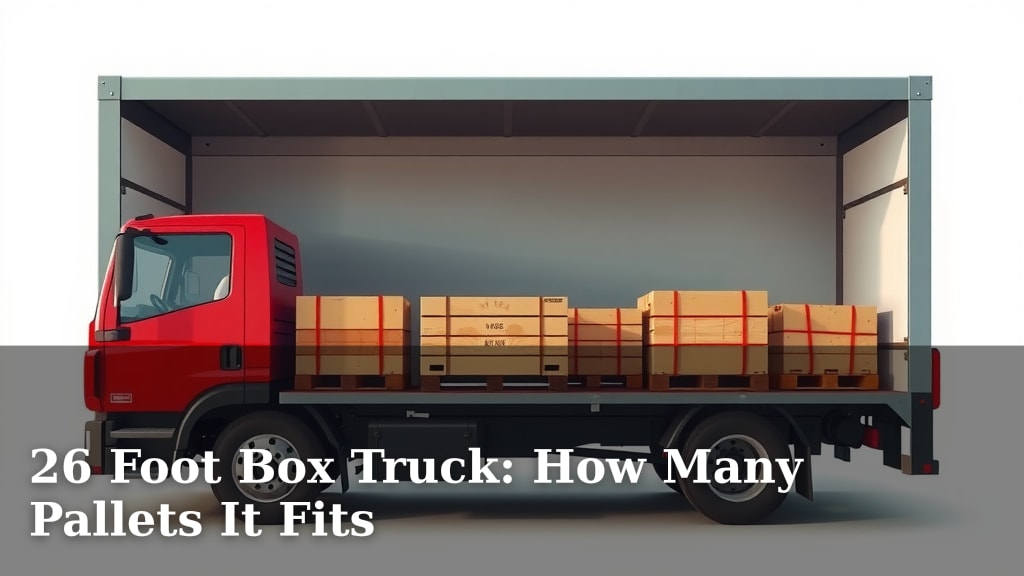
A standard 26-foot box truck can typically fit between 12 to 14 standard pallets, depending on how they are loaded. This is a common size for moving companies and businesses needing to transport a good amount of goods. You’ll want to make sure your pallets are spaced correctly for the best fit.
Understanding your pallet count is key for efficient logistics. Whether you’re planning a local delivery or a long-haul shipment, knowing the capacity of your truck saves time and money. This size truck offers a great balance for many shipping needs.
- A 26-foot box truck usually holds 12 to 14 pallets.
- Loading style impacts how many pallets fit.
- Standard pallet dimensions are important to know.
- Proper spacing ensures maximum capacity.
Now, let’s get into the details of how to best load your 26-foot box truck for maximum pallet capacity.
Understanding Your 26-Foot Box Truck’s Pallet Capacity
So, you’ve got a 26-foot box truck and you’re wondering just how many pallets you can squeeze in there. It’s a common question for anyone involved in shipping or moving goods. The short answer, as you’ve likely seen, is around 12 to 14 standard pallets. But, as with most things in logistics, there’s a bit more to it than just a number.
This truck size is a real workhorse for many businesses. It offers a great blend of cargo space without being overly cumbersome to drive or maneuver. Let’s break down what influences that pallet count and how you can maximize your truck’s efficiency.
Standard Pallet Dimensions: The Foundation of Your Load
Before we talk about fitting things in, we need to talk about what “things” are. In the shipping world, a standard pallet is usually 40 inches wide by 48 inches long (often abbreviated as 40″ x 48″). This is the industry norm, especially in the US. Knowing these dimensions is your first step.
Why is this so important? Imagine trying to pack a suitcase without knowing the size of your clothes. The pallet is your “item” here. If your pallets are larger than this standard size, you’ll fit fewer. If they are smaller, you might fit more. Always verify your pallet size before you start loading.
The Magic Number: How Pallets Fit Lengthwise
A 26-foot box truck has an interior length of approximately 26 feet, or 312 inches. When you lay pallets down, you’re usually placing the 48-inch side along the length of the truck. So, let’s do some quick math.
If you divide the truck’s length (312 inches) by the pallet’s length (48 inches), you get roughly 6.5 pallets. This means you can fit 6 full pallets end-to-end down the center of the truck. This calculation is your starting point for understanding the truck’s longitudinal capacity.
Maximizing Width: Fitting Pallets Side-by-Side
Now let’s look at the width. The interior width of a standard 26-foot box truck is typically around 96 inches. Pallets are 40 inches wide. If you place two pallets side-by-side, with their 40-inch sides facing each other, that’s 80 inches (40″ + 40″).
This leaves you with about 16 inches of space between them (96″ – 80″). This gap is often called “aisle space”. It’s not enough to fit another full pallet, but it’s useful for bracing or smaller items. So, you can comfortably fit two standard pallets across the width of the truck.
The Rows: Combining Length and Width for Total Count
When you combine these dimensions, you start to see how the total pallet count is reached. You can fit 6 pallets end-to-end in a row. Since you can fit two pallets side-by-side, that means you can have two rows of pallets running down the length of the truck. This gives you a base of 12 pallets (6 pallets per row x 2 rows).
This is where the “12 to 14” range really comes into play. The 12 pallets are your straightforward, no-nonsense load. This configuration is straightforward and efficient for most situations.
What About That Extra Space? The Extra Pallets
Where do the extra one or two pallets come from? This often depends on how you arrange the pallets and the specific dimensions of your truck and cargo. Sometimes, if the pallets are stacked, or if there’s a slightly different configuration at the very front or back of the truck, you might squeeze in a thirteenth or even a fourteenth pallet.
This often involves clever loading techniques or slightly different pallet dimensions. It’s less common and requires more careful planning. For most standard loads, aiming for 12 is a safe bet, and 14 is a bonus if you can achieve it.
Loading Styles That Impact Your Pallet Count
The way you load your truck makes a big difference. Are you just throwing them in, or are you strategically placing them? We’re talking about strategy here.
Straight Loading vs. Pinwheeling
Straight loading means all pallets are oriented the same way. Usually, the 48-inch side faces the front of the truck. This is the simplest method and typically leads to the 12-pallet count. It’s predictable and easy to manage.
Pinwheeling, on the other hand, involves alternating the orientation of pallets. You might place one pallet with the 48-inch side facing forward, and the next with the 40-inch side facing forward. This can sometimes allow you to fit more, especially if you have space constraints or different-sized pallets. It’s a bit like Tetris.
How Stacking Affects Capacity
A big factor is whether your pallets are single-stacked or double-stacked. If your goods are stable and can be safely stacked on top of each other, you can potentially double your pallet count. A single-stacked load of 12 pallets becomes a double-stacked load of 24 pallets, provided your truck’s height allows and the cargo can handle the weight.
However, not all cargo is stackable. Fragile items, oddly shaped goods, or products that could be crushed if stacked won’t work. Always check the weight limits and the nature of your goods. Many guidelines suggest that double-stacking is only feasible if the cargo height is less than 8 feet (a common box truck interior height is around 8.5 feet) and the items are sturdy (National Highway Traffic Safety Administration).
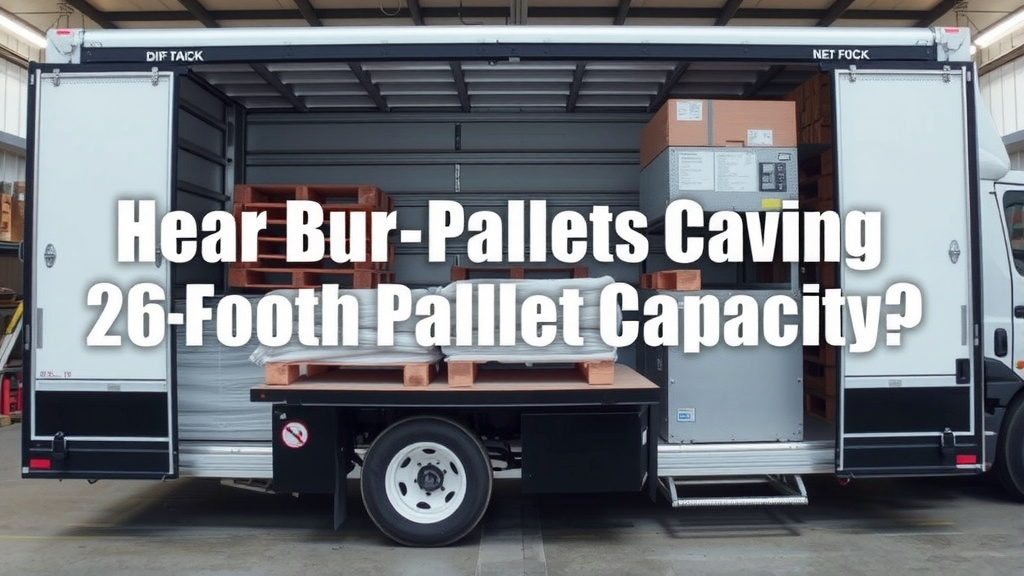
Calculating Your Load: A Quick Checklist
So, you’re ready to load. What should you keep in mind to get the most out of your 26-foot box truck? Here’s a simple checklist:
- Confirm your exact truck interior dimensions.
- Verify the dimensions of your pallets (are they standard 40×48?).
- Decide on your loading pattern (straight or pinwheeling).
- Determine if your cargo can be safely stacked.
- Consider any aisle space needed for securing the load.
- Always account for the weight capacity of the truck.
The Importance of Spacing and Securing Your Load
Even when you’re aiming to fit as much as possible, you can’t just cram everything in. Proper spacing is essential. You need enough room to maneuver pallets safely into place.
More importantly, you need to be able to secure your load. This usually involves using straps, blocking, or bracing. An unsecured load is a safety hazard and can lead to damaged goods. Ensure there’s enough space to properly tie down your cargo. Many regulations mandate securement to prevent shifting during transit (Federal Motor Carrier Safety Administration).
| Loading Scenario | Estimated Pallet Count | Notes |
|---|---|---|
| Single Layer, Straight Load | 12 | Standard, easy to load and secure. |
| Single Layer, Alternating/Pinwheeling | 13-14 | May require more careful placement, best for specific configurations. |
| Double Stacked, Straight Load | 24 | Requires stackable cargo and sufficient truck height. |
As you can see from the table, the possibilities expand dramatically with stacking. However, always prioritize safety and stability over just fitting more.
Factors That Might Reduce Your Pallet Count
Sometimes, even with the best intentions, you might fit fewer than 12 pallets. What causes this? Firstly, overhanging cargo. If your goods stick out past the edges of the pallet, they can interfere with adjacent pallets or the truck walls. This eats up valuable space.
Secondly, irregularly shaped items. If you’re not shipping on uniform pallets, but rather loose items that need to be palletized or secured within the truck, you’ll lose efficiency. Packing loose items is never as space-efficient as uniform pallets. Think about it: trying to fit round pegs into square holes.
Conclusion
So, you’ve learned that a 26-foot box truck typically carries between 12 and 14 standard pallets. Remember, this number can change based on how you load and stack. Always measure your truck’s interior and your pallets’ dimensions. Straight loading is straightforward, while pinwheeling might offer a slight edge. If your cargo allows stacking, you could potentially double that capacity, but safety comes first.
Before your next shipment, take a moment to plan your load. Confirming these details will help you maximize your truck’s efficiency and avoid costly mistakes. Happy hauling!
Frequently Asked Questions
Can I fit more than 14 pallets in a 26-foot box truck?
While 12-14 is the standard for a single layer, fitting more than 14 in a single layer is uncommon with standard-sized pallets. Exceeding this usually requires unusual pallet dimensions or a very specific, advanced loading technique. Always prioritize safe loading over simply fitting an extra pallet.
What are the exact interior dimensions of a 26-foot box truck?
The interior length is typically around 26 feet (312 inches). The width is usually about 96 inches. However, these can vary slightly by manufacturer. It’s always best to check the specific dimensions of the truck you’re using before you load.
What happens if my pallets are not standard 40×48 inches?
If your pallets are larger, you will fit fewer. If they are smaller, you might be able to fit more. It’s crucial to measure your specific pallets and do the math based on your truck’s interior space. Non-standard sizes can significantly impact your load count.
Is it safe to double-stack pallets in a box truck?
Double-stacking is safe if your cargo is stable, stackable, and doesn’t exceed the truck’s height limit (typically around 8.5 feet). Always check the weight capacity and ensure the goods below can support the weight of the items above without damage.
How much space is usually left between pallets in a loaded truck?
When loading two pallets side-by-side across the 96-inch width, you’ll have about 16 inches of space between them. This is often called aisle space and can be used for bracing or securing your load, rather than fitting additional items.